Those of you who know me well, also know that I faced the prospect of teaching quilting with more than a little trepidation. Give me a dozen nine-year-olds and I can teach them how to whittle successfully but an unknown group of women with unknown expectations ... all kinds of challenges come to mind. What supplies are needed? what skills might they already have? How do I explain things in my rather limited Japanese?
I got some very good advice and encouragement from my blogging friends and decided to begin at the end. I cut pot-holder sized squares (a little over 7 inches) from three different Japanese quilted fabrics, and bias strips from some navy solid cotton in my stash.
The two pieces were put back-to-back and I showed them how to put a bias binding around the edge.
After that, I had prepared both log-cabin strips and the square with triangle pattern I had used at the Women's Conference earlier in the year. I would let them choose and make whatever they liked in whatever size they had time for.
The setting of the first day class was much to my liking. There were low tables with the women sitting on the floor.
That was perfect for me because I am a floor-sitter and you can move around comfortably from person to person.
We set up a few tables to hold supplies and some later arrivals sat at those tables with chairs.
The next thing, that made me feel more comfortable, was the majority of these women were my own generation, hovering a few years one side or the other of 80. Growing up in hard times gives you plenty of experience with "making do". Though I had wished I could show up with lots of fancy fabrics, what I did take worked well enough.
Interestingly, I was the only left-hander in the room for both of the classes. That was not all that bad because I can show people how to do things working up-side-down. Once the bias is begun in the right direction and the first corner is turned, each new corner re-enforces the lesson.
Looking at the choice for the second project, every single person selected the square in a square. I had not prepared enough of those so I was able to show the women how to use sandpaper and a template to mark the fabric. I let them select their own choice of solids and prints. They learned how to draw the quilt pattern they selected on to the center piece and found suitable fabric in the scrap donations for the backing.
A volunteer came to help and she was very good at helping them select colors that went well together. The volunteer in the above picture is a British lass who spoke Japanese quite well but was just learning the basics along with the class.
The volunteers in the orange vests set up the ironing board and helped the women select and cut the backing as well as the batting.
Here, they are trying different fabrics.
I was kept pretty busy going around the tables so did not have much time for taking photos.
There was a young man there who took many photos and videos. In the evenings he was editing them all into some kind of presentation.
These women were quite familiar with basting.
Turning the backing and folding the corners was a familiar technique used in making kimono or yukata. It even has a name. The younger generations would not know how but the older women could show them how to do it.
Here is the first group at the end of the day.
Everyone seemed happy with the project.
I heard that the next day they got together again and finished up their projects.
I went back to the hostel that night and cut more bias and more triangles from some of the donated pieces of fabric so as to be ready for the next day.
The second day went much like the first except the participants were all seated at tables like in the picture above. Each activity room is like the other in every housing area. There are 60 compounds of these temporary housing and 2000 of these temporary homes.
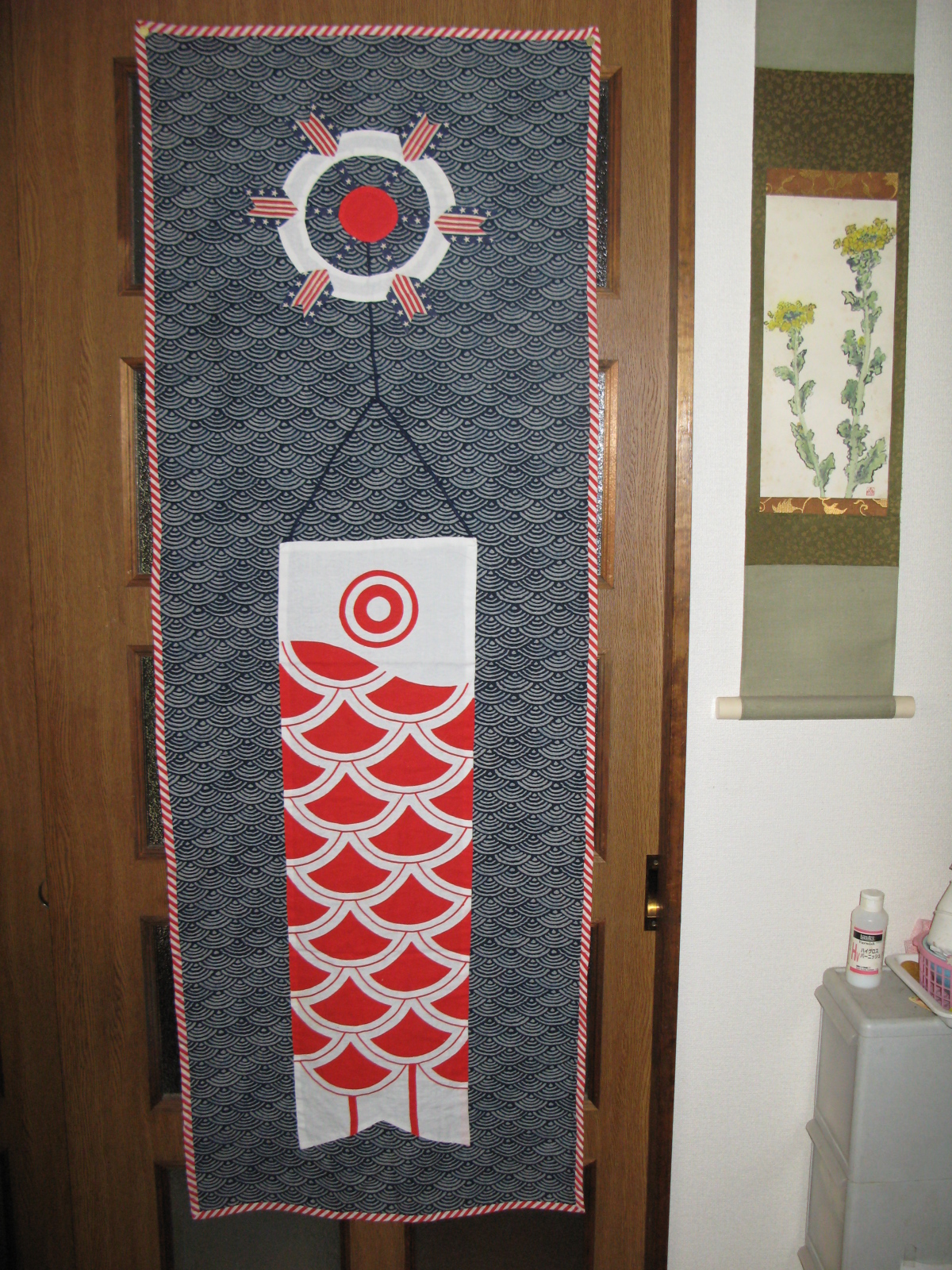
This activity room was gaily decorated with large carp streamers, inscribed with encouraging messages.
An elderly gentleman came in during the activity, hoping to find something else going on and a cup of tea. While some were telling him that his desired activity was another time, Reverend Iwatsuka kindly invited him to the room in the background for a cup of tea and some talk.
After two years in these "temporary" shelters, the women are good at building community ...probably even without quilting. It is the men who are now without work and connections to former friends, scattered all over the 60 locations, who stay at home, maybe drink, and have little to keep them occupied.
Whereas Adachi-san had prepared a lunch for the first group, these women took a break and went home for lunch.
They soon returned and seemed to be enjoying talking and working.
I did not get a group picture at the end but I did grab my camera for a few table shots along the way.
Just turning the binding on this and it looks very nice.
A little different quilt pattern... oh, they took the rest of the patterns for later use so I'm glad we had many copies.
And, this quilter used two different colors of thread and very teeny-tiny stitches.
This quilter chose to quilt outside the ditch and picked a ring of hearts.
I also showed them how they could fold paper and cut it to make their own designs, just like my little granddaughter does. We laid some together so they could see the possibilities of joining blocks for something larger like a table runner or place mats.
All in all, I think the classes were a success. I was asked to return and do it in other areas. two out of sixty is just a drop in the bucket. I think that next time it will be a bit easier to prepare.
I took my paper diary which they could look through. I took the log cabin sample I had prepared and turned it into a glasses case.
Leaning over the tables did not make my back very happy, so I was glad that was the last day.
We reversed the trip back to Tokyo, car to the bus station, bus to the train to Tokyo, and local train to home ... just in time to dump my stuff and go to choir practice. Friday I re-packed and went out to Cub Camp where I taught little boys to make things of leather. (and parents, to help but not do it for them). The weather was beautiful ... just right for young Scouts. Nikko went with me, as she loves camping and open spaces and people willing to play with her.
Late Saturday night I excused myself after the campfire and Leader's Roundtable and drove back home in time to grab a wee bit of sleep before heading off Sunday for a date with Mozart and an evening Boy Scout event.
I was so tired at the end of the day that I got on the train going in the wrong direction by mistake and had to retrace my route to get home. (Then I rode past my stop and had to head back) I don't do that very often! Good thing it was not the last train of the day.
The take-along work was a fine distraction from other worries and the owl got wings.
Now I have to add the feet and the tail.
I think he enjoyed the trip and gained a few admirers.
This morning began with the regular early morning rice delivery ... another week has begun ... this one, hopefully, a bit less hectic.
A week's worth of cleaning, dog hair accumulation, plant tending, and the like awaits my attention and mid morning brought a go-to-meeting with all my precious chicks and chicklets, the youngest celebrating her fourth birthday.
For all the frustrations of the computer age, there are rewards as well. Right Tanya? (she got a virtual graduation this week).
I am grateful to all my blogging friends for their ideas, their encouragement and support and the prayers that carried me through. A week with no internet was possible, knowing you would be here to meet me upon my return.
As to Tohoku, Two years is a long time for "temporary" and as yet the new building has not begun. The land, not yet cleared. Many lost their homes but still have mortgages to pay and no jobs ... I understand that situation, but at least we have a house. As memories of the tsunami grow old and dim, thousands of people are facing challenges with no end in sight. How many can begin again at age 80? There is much to ponder and pray for. The surface has been barely scratched.